
On Wednesdays, I teach a group of gifted and talented fifth graders, which means my weeks are rarely quiet and never boring. These are kids who ask big questions and are not satisfied with easy answers. They want to know how things work, why systems are unfair, and what they can do about it. They also want to know what the weirdest animal in the ocean is and whether it can kill you. This week’s class managed to cover both ends of that spectrum: microloans and nudibranchs with the popular sea shanty “What do you do with a homeless kitten.”
Microloans are small loans that can make a big difference. Instead of a bank giving thousands of dollars to a big company, a microloan might be just enough for one person to buy a goat, a sewing machine, or a small stock of items to sell in a tiny store. The amounts are often so small that many of us would not think twice about spending that much on a weekend trip or a new gadget, but in another part of the world, that same amount can change the course of a family’s life. The person who receives the loan agrees to pay it back over time, and as they do, they build a little business, send their children to school, and maybe even help others in their community. It is not charity in the usual sense. It is a partnership based on trust and effort.
You might wonder why a veterinarian in Flatwoods is writing about microloans in a local newspaper. The answer is that poverty is a leading challenge to wildlife preservation. My fifth graders and I were wrestling with the idea that small choices here can ripple out into big changes somewhere else. We talked about how someone far away, in a country most of them will never visit, might be trying to start a small business but has no access to a regular bank. We looked at real people and real projects that needed help: a woman who wanted to buy chickens, a man who needed tools, a group trying to expand a small farm.
The kids worked in pairs to choose which loan to sponsor. It was my money, but their decision. That sounds simple, but deciding in twos takes time. They had to read, think, explain their choices, and sometimes argue a bit before they agreed. One would be drawn to helping a farmer, the other to helping a shopkeeper. They had to listen to each other and decide whose reasons were stronger. Gifted kids are not always gifted at compromise, so this was its own lesson. While some pairs were still deep in discussion, others had already decided. Rather than let half the class sit idle, we shifted gears and headed for the ocean floor.
Their brains were already in “big picture” mode, thinking about lives far away and systems they could not see. It felt like a good moment to remind them that the world is full of other hidden lives, not just human ones. So we took a sharp turn from human finance to ocean biology and landed on one of my favorite groups of animals: nudibranchs. If you have never heard of nudibranchs, you are not alone. Most people have not. They are often called sea slugs, which is an unfortunate name for something so spectacular. When you hear “slug,” you think of something gray and slimy eating your garden plants. Nudibranchs are more like living jewels crawling along the ocean floor.
The name nudibranch comes from Latin and means “naked gills.” Many of them have little feathery plumes on their backs that they use to breathe. Those are their gills, right out in the open instead of hidden inside like in fish. On their heads, they have two horn-like structures called rhinophores. They are not horns at all, but chemical sensors. The nudibranch uses them to “smell” the water, to find food and sometimes mates. Imagine if your nose stuck up like two little antennae and could tell you exactly where dinner was hiding. Their bodies are soft, with no shell as adults, and they come in colors that would make a paint store nervous about keeping enough stock. Neon blues, hot pinks, bright oranges, and patterns that look like they were designed by an artist.
Nudibranchs are mollusks, related to snails, clams, and octopuses. Most of their relatives keep their shells for protection. Nudibranchs give theirs up as they grow. That seems like a bad idea until you see what they do instead. Many nudibranchs eat poisonous animals like sponges, anemones, or even other nudibranchs. Instead of being harmed, they steal the toxins and store them in their own tissues. Then they advertise that fact with bright warning colors. It is the ocean’s version of a “Do not touch” sign. A fish that takes one bite of a toxic nudibranch usually remembers the mistake and does not try again.
Some nudibranchs are even more clever thieves. They eat animals with stinging cells, like hydroids and anemones, and somehow move those stinging cells into their own bodies without setting them off. They tuck the stolen stingers into little finger-like projections on their backs. When a predator comes along, it gets a mouthful of stings. The nudibranch has turned its prey’s weapons into its own defense. That would be like you eating a cactus and then being able to use the spines later when someone tried to grab you. Evolution produces some impressive tricks.
Others borrow from plants instead of stingers. Certain nudibranchs eat algae, or animals that have algae living inside them, and keep the algae cells alive in their own tissues. The algae continue to photosynthesize, turning sunlight into energy, and the nudibranch uses some of that energy. It is not quite a plant and not quite just an animal at that point. It is a partnership. Scientists call this kleptoplasty, literally “stealing plastids,” the parts of plant cells that do photosynthesis. The ocean is full of these quiet collaborations, and nudibranchs are some of the more colorful examples.
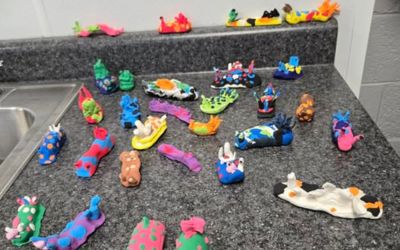
While the last few pairs were still weighing the pros and cons of different borrowers, the rest of the class started turning these strange facts into something they could hold. I handed out colored air-dry clay and told them they were going to make their own species of nudibranch. Suddenly the room was full of small hands rolling, pinching, and twisting clay into soft-bodied sea slugs. Some added tall, exaggerated rhinophores. Others covered the backs with frills and spikes. A few made theirs so covered in bumps and folds that you could almost imagine them blending into a coral reef. They were in the same outrageous colors the real animals wear.
As they worked, they had to answer questions about their creations: What does it eat? How does it avoid getting eaten? Where does it live? How does its color help it survive? Those are the same questions marine biologists ask about real nudibranchs. Without calling it that, the kids were doing science with their fingers. The ones still deciding on loans were doing a different kind of thinking, weighing needs and imagining futures. The room held both kinds of work at once: quiet moral math at one table, wild ocean creativity at another.
It might seem like the microloan exercise and the nudibranch sculptures live in different worlds, but there is a thread that connects them. Both required the students to imagine lives and systems beyond their own daily experience. With microloans, they pictured a farmer or shopkeeper in another country and tried to understand what a small amount of money could do. With nudibranchs, they imagined an animal on the ocean floor and thought about how its body and behavior would help it survive. In both cases, they had to step outside themselves.
Nudibranchs survive because of relationships: with the algae they borrow, the stingers they steal, and the specific sponges or corals they eat. They are part of a web. If one part disappears, the others are affected. Microloans are also about relationships. Someone far away trusts that a stranger will use the money well and pay it back. A community may depend on that small business for food or services. When it works, more children go to school, more families eat regularly, and the whole community becomes more stable. Small actions ripple outward, whether it is a tiny sea slug recycling toxins on a reef or a small loan helping a family build a safer life.
Watching a room full of gifted fifth graders argue cheerfully over which loan to choose while others shape tiny sea slugs out of clay is encouraging. They move easily from caring about a farmer they will never meet to being fascinated by a tiny, toxic, neon-blue nudibranch they will probably never see in person. They remind me that curiosity and kindness can share the same space. The world is full of problems to solve and wonders to discover. Our job as adults is to give kids the tools, information, and time to engage with both.